Rocket Science
Jean-Kenta Gauthier Vaugirard
4 rue de la Procession 75015 Paris
Opening reception: Saturday 10 October, 4-7pm
Public conversation: Saturday 10 October at 5pm with Frédéric Paul [RSVP at rsvp@jeankentagauthier.com]
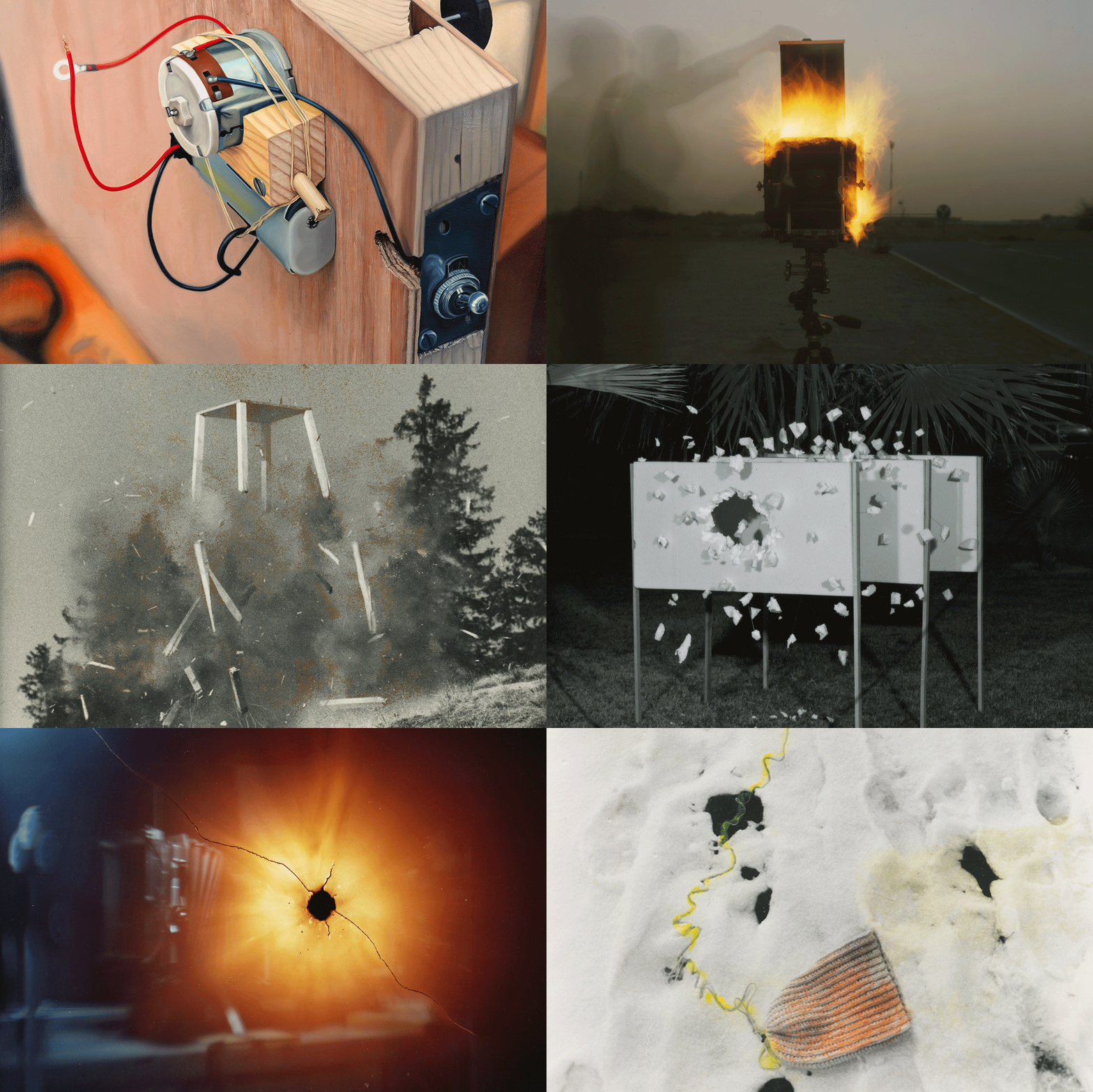
Sure, it’s not rocket science. Yet Robert Cumming, Steven Pippin, and Roman Signer have all demonstrated extraordinary ingenuity in embarking on technically ambitious and often mind-boggling projects. Rocket Science brings together photographs, sculptures, and a large-scale painting, works that often involve explosions, large or small, real or illusory, and that have required considerable inventiveness. Humour, too, although the gag is never an end in itself. “There’s no reason why one shouldn’t laugh,” says Roman Signer. The exhibition also takes place within the framework of the Bicentenary of Photography, and what better way to celebrate photography’s vitality than to begin by physically destroying cameras?
After training in photography and then turning to sculpture and mail art, Robert Cumming (1943–2021) devoted himself almost exclusively to photography from the late 1960s onward. This was initially because photographic reproductions of his own sculptures seemed more interesting than the sculptures themselves. Having left the US East Coast for California, he turned his house and backyard into his studio and the backdrop for his staged scenes. He repurposed everyday objects, designed sets, played with scale, and conceived the whole as a collection of sculptural props for his photographs, which he took with a large-format view camera. In this way, he developed an art of illusion: the sequence Barrier Explosion (1973) appears to be a chronophotograph, but closer inspection reveals that everything is sculpture. The same is true of Exploding Paint Brush (1973), and of From Minor Household Mishaps… (1975), in which a suspended electrical plug, in fact fixed in place, appears to have been hastily pulled out for the protagonist’s benefit. This idyll with the medium came to an end around the turn of the 1980s. Seeking to free himself from photography and its problem of scale (although he worked in large format, he refused to enlarge his images), Robert Cumming set out in 1977 to produce ten large-scale oil paintings. He completed only three, as making them proved almost insurmountably difficult. While the first (Mesh Hammer, 1977) was known, the other two were discovered only recently. Motorized Comma (Detail) (1978) stages a mechanism typical of his exuberant imagination: a black comma mounted on an axle and activated by a motor (the switch is set to “on,” but the wires are disconnected). The prop-object almost certainly existed, as those featured in the other two paintings have been documented. Beyond the hyperrealism characteristic of the 1970s, the treatment of blur in the background betrays an image that is purely photographic, as though the scene were being viewed through the ground glass of a view camera. The technical mastery is breathtaking.
“To try to curb my compulsion to take photographs, it seemed necessary to begin by physically destroying the camera”: this is how Steven Pippin (born 1960) sums up his intention. As early as the 1980s, he had converted public photo booths into pinhole cameras, transformed the toilets of a train running between London and Brighton into cameras, and repurposed washing machines as camera obscuras (using the drum as a support for giant negatives, replacing the glass porthole with optics, and placing the photographic chemistry in the detergent compartment). The photographs by Steven Pippin presented in the exhibition stage the destruction of photographic cameras. Those from the Non Event series (Minneapolis, 2010; Mamiya 330 (Professional) 6x6 Autoportrait Shot Through the Back, 2010), through the ingenious use of mirrors, lighting, and triggers, show the image being made at the very moment the projectile strikes and destroys the apparatus. deVere sequence (Camera being shot (Left to Right) Until No Possible Image Is Recorded) (2010) even documents the execution of the camera, which breathes its last after six shots. Steven Pippin’s ingenuity reaches another level when he places the weapon inside the camera itself: In Camera (2012) records its destruction from within. The works from the Eclipse series (2012), presented here for the first time, show the film sheets perforated by the bullet and fragments of the shattered optics, accompanied by contact prints that allow the resulting image to be seen more clearly. These eclipses are photographic attempts to align three planets: the bullet, the hole in the optics, and the perforation in the negative. When all three converge along the line of sight, the eclipse is total. When the bullet is off-axis and remains visible, it is partial. Some remain mere attempts. “RIP Photography” (“Feu la photographie”) writes Frédéric Paul in the publication accompanying the retrospective he devoted to Steven Pippin at the Centre Pompidou in 2017. The work attains the status of meditation through sculpture. In Non (2007), which Pippin considers a total work, the optics are replaced by an ingenious tubular structure that, with the help of four mirrors, allows the image to be focused directly onto the film. Another “philosophical camera” is Unrecorded Moment (2025), in which the addition of a double horn would allow the image to be transported from one moment to the next without being captured by either camera.
Having made sculptures in the 1970s, Roman Signer (born 1938) turned to actions around the beginning of the 1980s, “wanting to make people sensitive to simple processes.” He records these actions using photographic cameras and film cameras. He employs domestic objects, harnesses physical forces, and stages explosions, large and small, mostly around Appenzell, his native Swiss village, and St. Gallen, where he now lives. His flying tables are among his best-known actions: a rebellion against the idea of staying at home, against the family dining table. The tables are thrown out of windows or blown to pieces in the open countryside (Turm — Tisch, 1979). The exhibition includes rare vintage photographic prints documenting these actions. Coming from a sculptural background, Signer explains: “I am not a sculptor who creates forms. It is an art of experience. Something happens with it.” Another celebrated action, dating from 1983, features Roman Signer standing in the snow. His black cap is attached by a string to a red rocket; the rocket takes off and the cap flies away. Mütze mit Rakete (1983), a rare object, is a photograph enhanced with colour, serving as a conclusion to the action: both objects lie in the snow. One can imagine the artist’s satisfaction as he captures the image, as if celebrating the completion of his project.
The pairing of Robert Cumming’s Iron on Grass, Iron on Guns (1971) and Roman Signer’s Ersticken von Gras (The Suffocation of Grass) (1978) brings the exhibition to a close. Signer’s title reveals his ambition to go beyond Land Art and Richard Long’s famous sculpture A Line Made by Walking (1967): the impressions left by the removed plates bear witness to an ordeal endured by the grass. Once again: “I am not a sculptor who creates forms. It is an art of experience. Something happens with it.” In Cumming’s diptych, the grass has been ironed. The same iron heats weapons. It is absurd, it’s not rocket science, and it is unsettling.
— Jean-Kenta Gauthier, October 2026
Robert Cumming was born in Massachusetts in 1943 and died in California in 2021. Steven Pippin was born in the United Kingdom in 1960 and lives in London. Roman Signer was born in Appenzell, Switzerland, in 1938 and now lives in St. Gallen.
Frédéric Paul, curator in the Contemporary Collections Department of the Musée national d’art moderne – Centre Pompidou, curated the exhibition Robert Cumming, The Photographic Work, 1969–1980 at the Frac Limousin in Limoges, France in 1994. He has exhibited Steven Pippin’s work on three occasions: Study in Time and Motion at the Frac Limousin in 1995, Steven Pippin at the Domaine de Kerguéhennec, France, in 2007, and Steven Pippin: Optical Aberration at the Centre Pompidou in 2017.
Rocket Science is organised as part of the Bicentenary of Photography.